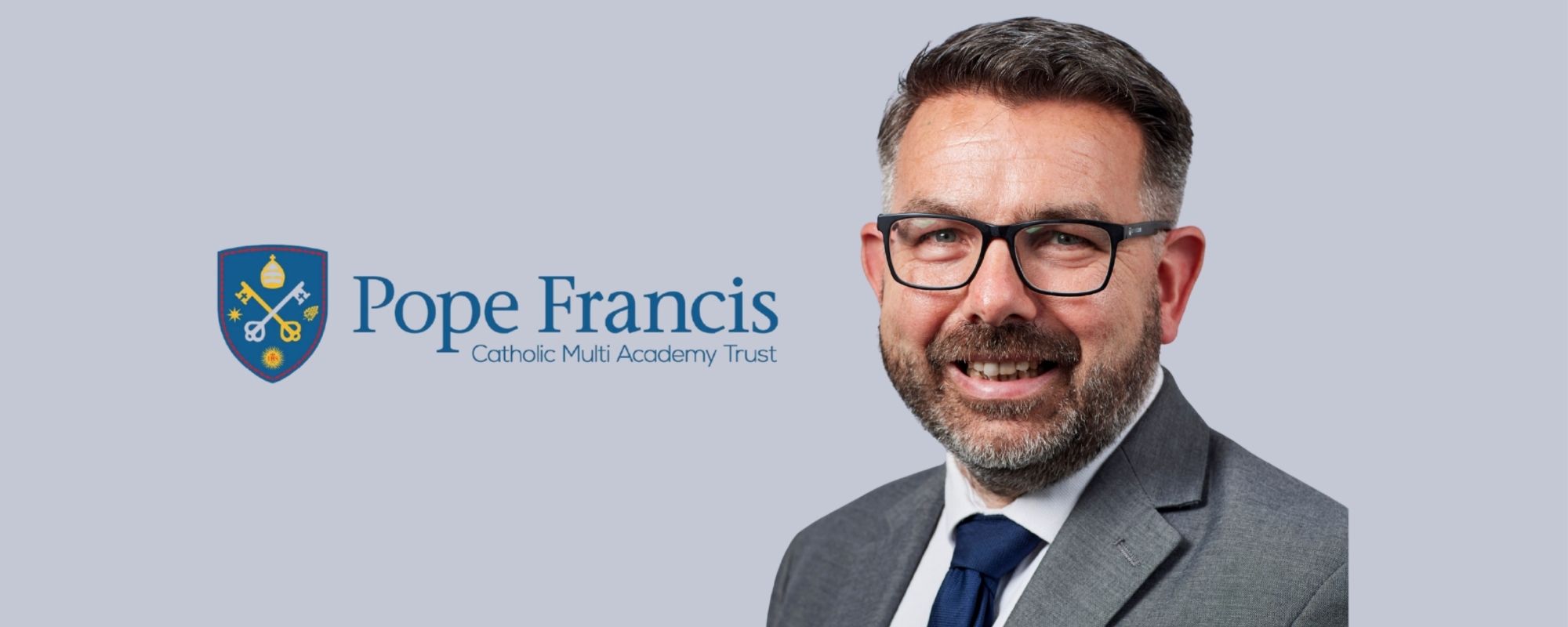
By Simon Hart
Andrew Dawson was responsible for 1,600 pupils in his previous job as head teacher at the largest school in the Archdiocese of Liverpool, St Mary’s Catholic High School in Leigh. For the now CEO of the Pope Francis Catholic Multi-Academy Trust (CMAT), though, that former remit may seem increasingly like small beer. Currently, his trust has seven schools in its network – a number set to grow with the archdiocese’s academisation strategy.
“By next year, we're anticipated to be around 20 schools,” he tells the Pic. “The following year, we could be up to 35 schools.”
Indeed, if all goes to plan, by 2032 all Catholic schools in Sefton and Lancashire will be under the Pope Francis umbrella. “An immense challenge” is how the native Prestonian describes the road ahead. “It’s a seismic shift in how we work, but hopefully will help strengthen and preserve Catholic education, and the schools will become stronger because they have this better network and wider family who’ll be there to support them.”
To wind back a few years, it was in 2022 that Andrew began in the role – exactly 30 years after first embarking on his teaching career at Alsager School in Cheshire. At that point, the trust had a single school – “St Edmund Arrowsmith, which was in special measures,” as he explains. Over the next two years, two other schools in the same situation – Sacred Heart and the Salesian Academy of St John Bosco (formerly Savio) – came on board. Where trusts typically start with stronger schools helping others in their orbit, Pope Francis did not have that luxury. “Our job was to help take them out of special measures and then build them up for the future. And we've done that.” In fact, this summer’s GCSE results saw three times more students secure 5+ in English and Maths at St Edmund Arrowsmith Catholic Academy - building on the significant progress already seen at both Sacred Heart Catholic Academy and Salesian Academy of St John Bosco over the last two years.
In 2024, Andrew welcomed four primary schools – Our Lady of Lourdes, Our Lady of Walsingham, St Edmund’s and St Thomas’, and St Mary’s – but now comes a process of significant expansion, the first wave of which will involve schools around Ormskirk, Skelmersdale, Crosby, Formby and Maghull.
“One of our big challenges will be maintaining the quality and support and the individuality of the schools as we grow,” reflects Andrew, who is keen to “respect the integrity, the history and the tradition of each of the schools so you still have that distinctive nature and that distinctive school, but within the benefits of a wider multi-academy trust.” To achieve this, there will be some “services that are arranged centrally” but also a “hub model” with four distinct areas across Sefton and Lancashire, each of them constituting “a smaller family of schools based on a geographical cluster.”
As for some of the benefits he hopes to provide, Andrew notes the access to resources and expertise that a school on its own may struggle to acquire – citing, for instance, the presence at Pope Francis CMAT of a head of SEND (Special Educational Needs and Disability). He draws from his own experience as a head teacher when offering further examples. “You've got quality resources and quality people in those areas of school life which almost drain head teachers' time,” he begins. “Head teachers want to be the lead professionals in terms of providing that climate for curriculum, for teaching and learning, for the pastoral system. Yet what happens so much is they get bogged down in other things.” Hence his CMAT provides finance, legal, HR and communications professionals. “We also have people to help them manage their estates,” he adds. “All of this allows the head teacher to focus on those critical aspects of education.”
For Andrew, a father of three grown-up children, the spiritual dimension of a Catholic MAT is fundamental too, and the Pope Francis team includes a “lead for Catholic life”. He adds: “It’s really important to be able to walk alongside our schools to support them and help them develop their understanding of Catholic life and mission.”
On that question of mission, Andrew’s own sense of purpose shines through. Much has changed in education since he began teaching, yet he believes some essential things endure. “It's still about that teacher being responsible for the development of those children,” he says. “The resources are different, but it’s still fundamentally about people.” And his own role, for which he commutes from his home in north Wales? “It's that opportunity of meeting so many different people and hopefully being able to help shape the structure of Catholic education for the next generation.” Exciting, if challenging, times lie ahead.
.jpg)