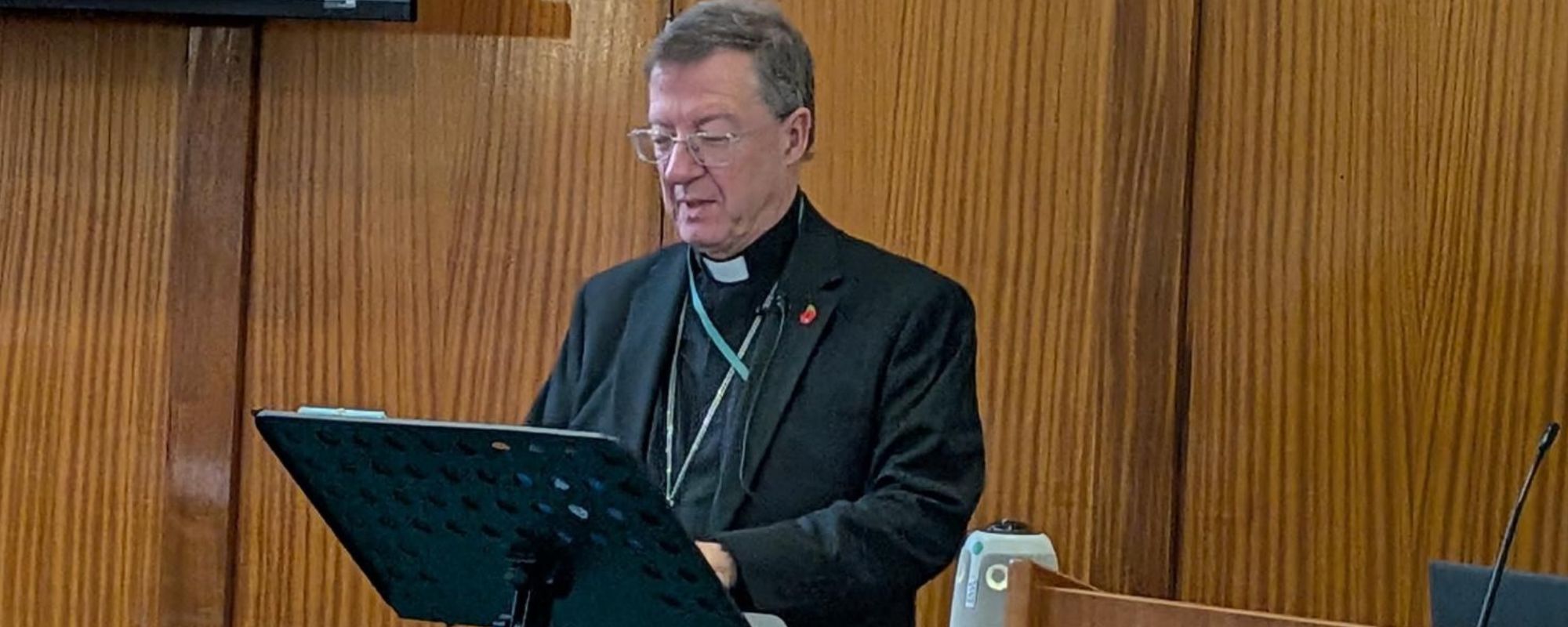
Archbishop John Sherrington gave the keynote address at the Archdiocesan Synodal Council on 7 November. You can read it in full below.
Introduction
I wish to thank you for your work together over this last year, especially for the ongoing development of the deanery synodal councils, families of parishes, and parish synodal teams. These structures seek to further the mission of the Church: in building up the parish communities, in deepening the life of prayer, in reaching out to others and accompanying them as they encounter Jesus Christ and reaching out to the poor and the needy.
The process of walking together leads to more effective discernment on the part of decision-takers, whether me as your Archbishop, those with specific responsibilities such as episcopal vicars, or your parish priest.
Aim
Today I want to reflect on the social outreach of the Church – the love for Christ which is our faith in action. As we reflect on our new parish structures emerging from the parish development plans, and our families of parishes, I think we need to widen our understanding of caritas as part of the vocation of every baptised woman and man, not only to provide a richer vision of our Christian faith but also to serve others better through faith in action. By caritas, I mean both the love itself, that charity that flows from God, and the organised work of service to which that love gives rise. We are a Church that looks outwards and loves others in need.
Called by Name: The Foundation of Trinitarian Love
“God is love, and he who abides in love abides in God, and God abides in him” (1 Jn 4:16). These words from the First Letter of John need to resonate more deeply in our hearts so that we grow in knowledge of God and respond more fully to the invitation to love God and our neighbour. The same verse begins: “We have come to know and to believe in the love God has for us”. As we reflect on this love, it overflows into our relationships with others as faith in action. God’s love moves us from the heart to respond with our hearts.
God is love. The God revealed to us by Jesus Christ and in whom we believe is a God of love, who exists in relationships of love. In the Trinity, we see the love of the Father eternally begetting and loving the Son, the Son offering his life to the Father, and the Holy Spirit, the Divine Person who is the love between them, pouring out that love into the world and into the hearts of women and men. We are caught up into this dynamic understanding of love, ‘Called by Name. Called to be with Christ. Called to Serve’.
We are created in the image and likeness of God. It is written into our DNA to love. This is the way we fulfil our lives. For most of you this love begins in families and then reaches out to others. For some it is the dedicated call to priesthood or religious life. We need to encourage once again our young people to consider this call to service.
Over the years I have heard some of the stories of the young people on the Lourdes pilgrimage. On the journey outwards, I remember one lad saying, ‘I don’t know why I am here or what I am doing.’ At the end of the pilgrimage, he was happy and loving every moment. He said, ‘this has been so good (Boss!) and I want to come again’. He had discovered how ‘love changes everything’ and brings fulfilment as well as giving purpose to his life and serving another person.
It was this understanding of the power of love that prompted Pope Benedict to write his encyclical ‘Deus Caritas Est’ (God is Love) in 2005 (twenty-one years ago!). Its first part reflects on the nature of love itself; its second presents the Church’s charitable activity as a manifestation of Trinitarian love. Our service flows from the love of the Trinity; our Christian faith enriches our action.
Called to be with Christ
When Jesus chose the Twelve, he called them first “to be with him” and then to be sent out (Mk 3:14). Our service begins in that being with him: in prayer, in the Eucharist, in listening to his word. Pope Benedict reminded us that those who serve need an encounter with God in Christ that awakens their love and opens them to others. Then love of neighbour “will no longer be for them a commandment imposed, so to speak, from without, but a consequence deriving from their faith, a faith which becomes active through love” (DCE 31a; cf. Gal 5:6). Without prayer, our action risks becoming mere activity; rooted in prayer, it becomes the love of Christ at work in us.
The gospels reveal to us the multi-faceted aspects of the love of Jesus Christ for God’s holy people. Jesus teaches the parable of the shepherd seeking the sheep that has strayed, the parable of the woman searching for the lost coin, the Father who waits for his prodigal son to return; these parables reveal the God who pours out his mercy inviting our response in love. As Church, we are called to be servants of mercy to those in need in whom we meet the suffering face of Jesus.
Called to Serve
The parable of the Good Samaritan shows us how this love acts. As you know there was long-standing hostility between Jews and Samaritans, rooted in centuries of religious and historical division. The road from Jerusalem down to Jericho was a dangerous and lonely road and so a common haunt for robbers and thieves. In the parable a man is attacked and left for dead. The priest and then the Levite pass by.
The man who stops is a Samaritan. We can picture him approaching, getting down from his animal and kneeling to look into the man’s face to see whether he is alive or dead. He is moved with pity for him, bandages up his wounds and takes him to the inn to look after him. He looks beyond religious and ethnic boundaries, overcomes any prejudice, and sees the person in front of him, the one in need. The wounded man’s suffering face draws out his love. He gives more than anyone could ask: he pays the innkeeper and promises to return. The Samaritan is Jesus to us!
Christian charity is first the simple response to immediate need and specific situations. It begins by seeing the face of the person in need, whether hungry, naked, sick, or in prison. You will recall that I finished my address last year with a quotation from Pope Leo’s first Apostolic Exhortation Dilexi te: On Love for the Poor, ‘Love for the Lord, then, is one with love for the poor’ (DT 5). Later he writes, ‘Love for the poor – whatever the form their poverty may take – is the evangelical hallmark of a Church faithful to the heart of God.’ (DT 103).
In our parishes and communities there are many forms of poverty, each calling for a response from the Church. Some require an immediate response to need; others call for more structural change. Recently in conversations in parishes, I have heard of the ongoing challenge of food poverty, the challenge to families to feed their children during the school holidays when schools are closed and there are no meals, the loneliness and isolation of the elderly.
I have heard prisoners in HMP Walton talking of the fear of getting out and wondering how to manage their addictions. As one young man said, ‘I am at stage 3 of AA. It’s great. But what happens when I get out of here? I go to the pub to watch Liverpool, have a Pepsi but you know, when you go to the barber’s, you always come out with a haircut.’ It is good to know that Ken McCabe and others are building the New Vision Community Chaplaincy and finding parishes of welcome to give a pathway from prison to parish.
Pope Leo also reminds us that the poor are not simply the objects of our compassion (DT 79). They are our brothers and sisters, with their own wisdom and gifts, and they have much to teach us about the Gospel. Our response to poverty must therefore include listening to those who experience it and working with them to change the situations and structures that keep people poor, as well as meeting immediate need. As Church we are not individuals gathered together, but we are one family, brothers and sisters called to serve.
Caritas in the Archdiocese
In Deus Caritas Est, Pope Benedict recalled that the Directory for the Pastoral Ministry of Bishops (2004) had set out the duty of charity as a responsibility of the whole Church and of each bishop in his diocese. He stressed that the exercise of charity is an action of the Church as such and that, like the ministry of Word and Sacrament, it has been an essential part of her mission from the very beginning (DCE 32). Many dioceses have organised this work through Caritas.
In the Archdiocese of Liverpool, the name and work of Caritas has been carried very successfully by Nugent. There are historical reasons for this. I have enjoyed conversations with Jo Henney, Nugent’s CEO. Nugent provides specialist care and pathways of opportunity for persons who are severely disadvantaged and have high need.
I was privileged to visit a specialist centre for teenagers with high need and requiring a specialist educational home environment in which to learn. It was a remarkable place of love and care. Another project was a home helping young adults to live with greater freedom and security. A third moment was visiting a care home for elderly people with various medical and health needs. I appreciate and thank all concerned with the work of Nugent and how it fulfils the mission of Caritas.
But I think we need to develop a wider understanding of caritas across the Archdiocese in which Nugent has a vital part. This wider vision needs to shape hearts and minds of all the baptised in our schools and families of parishes. Faith in action is something to be celebrated and I think better coordinated as we move into new and wider structures of parishes and families.
I am sure there is caritas activity in every parish and school. It may be a group of older parishioners enjoying a warm space, a cup of tea, which overcomes loneliness and isolation. It may be chatting and knitting hats for seafarers. Stella Maris always needs hats. Caritas includes the outreach into the community of the SVP. It includes a school project raising money for a local charity and many parish-based foodbanks, which are often ecumenical and interfaith based. St Thérèse of Lisieux invites us to do the little things of life with extraordinary love.
The outreach of the love of the Church is broad. Caritas is the mission of the Church in the local area, the neighbourhood, and serving local needs. I wonder whether we might not be more effective when we work together as families of parishes and then deaneries in seeing the need, judging what we can do, and acting for the good of others. See – Judge – Act is the method of caritas in every parish and school; it is deeply synodal as we accompany people in their need.
“If you see charity, you see the Trinity”, wrote Saint Augustine (quoted by Pope Benedict in DCE 19). Through her love for others, the Church expresses the mystery of the Trinity. It is a call for our parishes to build ever deepening relationships of love reaching out to others in need.
Deaneries and parishes have begun the process of reflection on their mission in the Archdiocese. Together we are asking how the Church can better proclaim Jesus Christ to all peoples and live our mission more effectively. Schools are also beginning to consider how they work with others for the good of all the children in Catholic education and reach out to others.
Accompaniment must also be at the heart of our reflection on how the Church makes Christ’s love real and comes to the aid of the poor, those in need, the hungry, the thirsty, and the stranger. Maybe our deacons, as servants of mercy, have a special ministry here?
I propose three things to you:
- that you make charity ever more real across your deaneries.
- that each family of parishes within a deanery maps the caritas activity already happening in its parishes and schools, using See – Judge – Act and that you reflect on this at your Deanery Synodal Council to identify the next steps.
- that each deanery considers how it better coordinates its caritas as faith in action and helps build a wider understanding of Caritas across the Archdiocese.
The more we see charity, the more we see the Trinity. Living charity, our caritas, is the mission of the Church and there we meet the God who is love.