


Fr James Finnegan reflects on his experiences among Christian communities in the Holy Land.


.jpeg)
Fr James Finnegan reflects on his studies in Rome, his experiences among Christian communities in the Holy Land and Iraq, and the importance of supporting Arabic-speaking Christians in Liverpool.
When Archbishop McMahon confirmed that he wanted me to continue with further studies in Rome, he asked me to come and see him with some options of what I might do for a License. I had always had a great interest in the culture, peoples, traditions and languages of the Arabic-speaking world, and I had a particular love for and fascination with the Holy Land, so - when I found out about the existence of the Pontifical Institute for Arabic and Islamic Studies (PISAI) - it seemed almost providential. I must admit, I never really imagined that the archbishop would go along with it, but he immediately recognised the importance of encountering those from backgrounds different from our own in the missionary work of evangelisation.
This has been my experience at PISAI, one of encounter. Encountering Muslim brothers and sisters, and sharing with them who the person of Jesus Christ is in my life, and preaching the Mystery of the One God in Three Persons, whilst also learning from them, and entering into dialogue with them, without abandoning the truth that we hold dear as Christians.
It has also been an experience of encounter with other Christians in the Arabic-speaking world. My studies have led me to Palestine, Israel, Jordan and Iraq, where I have had the joy of meeting an amazing array of Christians.
In the Holy Land, Christianity - on the whole -can look very different from what we are used to in the Latin/Western Church. There, the majority of Christians are either Greek Catholics (Melkites) or Greek Orthodox, both of whom use the Divine Liturgy of St John Chrysostom for their Eucharistic Celebrations (unlike we Latins who use the Roman Missal).
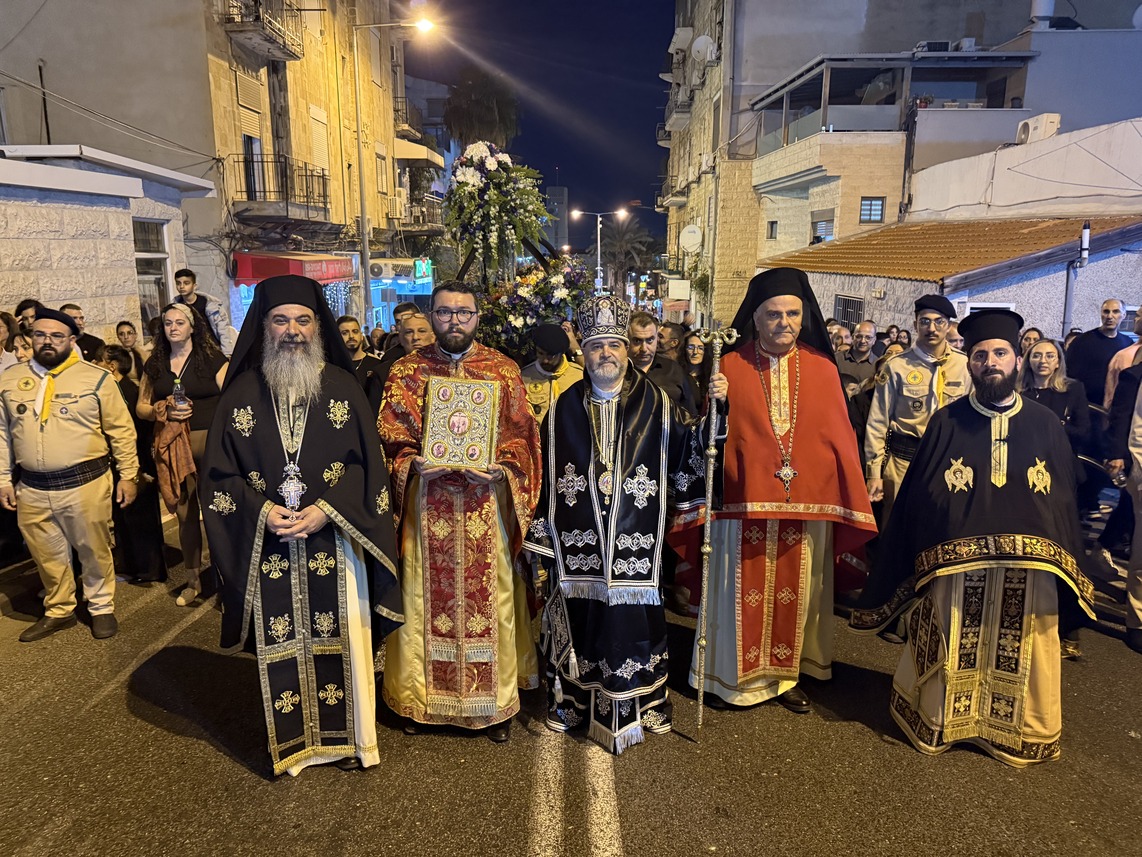
Most of my time in the Holy Land has been spent amongst the Melkites, especially in Jerusalem and Haifa, but I have been blessed to get to know the Latin Catholic community too, whose wonderful work and witness is spearheaded by the Franciscans and diocesan priests of the Latin Patriarchate of Jerusalem. Over the past three years, I have made many dear friends in the Holy Land, and have visited as often as possible simply to be immersed in the beauty and complexity of Christian life in the land of Our Lord, and to worship amongst those who are the living stones of the Church.
Wherever one worships, it can be strange at first to hear Arabic used as the language in which the liturgy is celebrated. Some would have us think that Arabic is a language used exclusively by people who are utterly alien to us, but we must remember that somewhere between 10 to 15 million Arabic-speakers in the Levant, Iraq, the Arabian Peninsula and North Africa are fellow Christians, our brothers and sisters in Jesus of Nazareth.
I deliberately don’t use the term ‘Middle East’, and for many reasons. But one of those is that it can make us think of an entire region as one homogenous ‘block’, where everybody thinks, acts and goes about their life in the same way. But the richness and diversity of the Arabic-speaking world is even visible amongst those who belong to the same ‘group’.
.jpeg)
Christians in Iraq, for example, are a markedly different community from Christians in the Holy Land. The overwhelming majority of Iraqi Christians are members of the Chaldean Catholic Church (one of the 23 Eastern Catholic Churches in full communion with Rome). Not only is their liturgy different, but their Arabic dialect is different, their food is different, their traditions, their music, their mannerisms, all different.
I had the immense joy of spending a month in Ankawa and Erbil, Northern Iraq, last Summer, where much of the Christian community is made up of refugees from nearby Mosul and the Nineveh Plain who had fled their homes in 2014 after the invasion of ISIS. Though a community which has been tested in the fire of persecution - including the torture and murder of family members and friends - they have never hidden their joyful witness to Jesus Christ.
Iraq strengthened my faith and filled me with great hope for the future of the Church. I was able to help in the final stages of preparing children to make their first confession and to receive Holy Communion for the first time, whilst also living alongside a group of other young priests and their wonderful archbishop, who were a great encouragement tome both spiritually and in improving my Arabic (they served me grilled tongue one evening insisting that it would make my Iraqi dialect better…the results have yet to be seen!)
I was also given the opportunity to participate in the Ankawa Youth Meeting 2025, which is something of a ‘World Youth Day’ for Iraqi Christians, who had come from all over the country to participate in the 5-day-long event, and to meet fellow young Christians. It was a real source of grace to hear their stories, to pray with them, relax with them, and share precious time with such wonderful people.
The Church in Iraq is flourishing, and her witness - in countless social programmes, in the building and rebuilding of civil infrastructure, and in the care of all peoples of all faiths - is a necessary part of society. I pray to return there soon, to continue to learn from Iraq’s Christians what it means to be a courageous witness to Jesus Christ.
One of the ways in which we witness to Jesus is in our worship and in our Christian fellowship. For many of us, this is an easy and natural part of our week. We attend Mass in a language which is familiar to us, and then have some social time together once it is over.
But for those in our archdiocese who have come here from different parts of the world, it is not always so easy.
In July, I will offer a Mass in Arabic for Christians in Liverpool who speak Arabic as a native language (as well as for anybody else who might be interested), and I hope for us to have some social time together afterwards. As of yet, I know only of two families (one from Syria and one from Lebanon) who are aware of this opportunity, but - no matter how many we are - we cannot quantify the grace and joy that comes from being able to worship together in our own language, especially when we may be feeling far away from home.
If you know of any Arabic-speaking Christians in your own communities who would appreciate this opportunity, then please pass this information on to them.
Above all, let us never forget the words of the Psalmist: ‘For the peace of Jerusalem, pray!’
Holy Mass for Liverpool's Arabic-speaking Christian community will be celebrated by Fr James Finnegan at 1.00pm on Saturday 11 July 2026 at Christ the King Church, Queens Drive, Wavertree, Liverpool, L15 6YQ. All are welcome.
.jpg)
.jpg)